
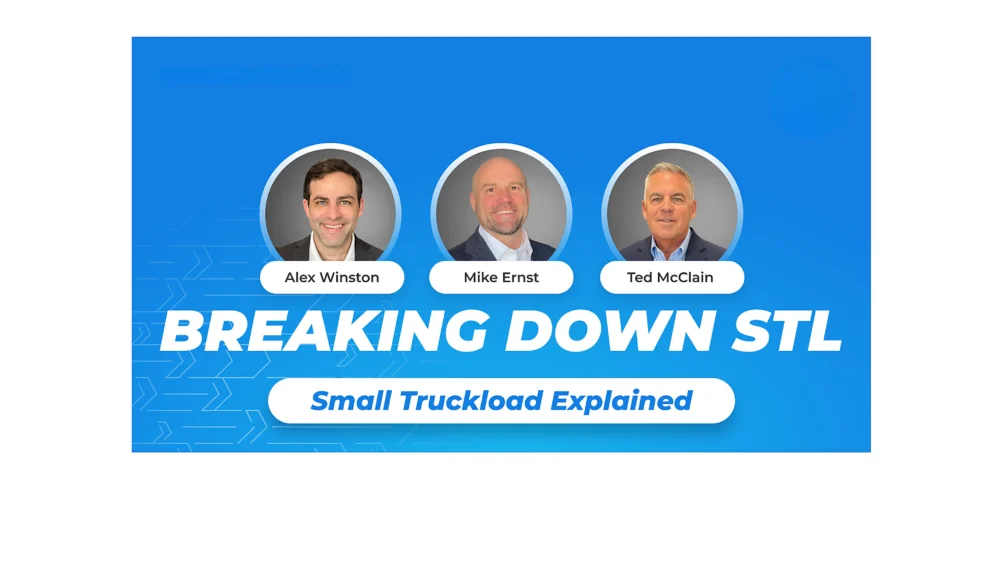
Breaking Down STL: Small Truckload Explained
Most freight decisions start with two familiar options: LTL or Full Truckload. But many shipments do not fit either model well.
Some freight needs more control than LTL can provide. Some shipments are too small for a 53-foot trailer. Some timelines are too urgent for traditional network movement. That is where Small Truckload, or STL, creates value.
In this article, Alex Winston, Chief Legal Officer, speaks with Mike Ernst, President, and Ted McClain, Senior VP of Sales, about what STL is, when it works, and why more shippers, brokers, and freight partners are turning to dedicated small-truck solutions.
What Small Truckload means
Small Truckload sits between LTL and Full Truckload. It uses smaller commercial vehicles — cargo vans, box trucks, and straight trucks — to move freight directly from pickup to delivery.
As Mike explains:
“STL, Small Truckload. So it’s really that space in between Full Truckload and LTL.”
The key difference is not only the size of the vehicle. It is the dedicated service model. With STL, the customer gets exclusive use of the truck. Freight is not combined with other shipments, moved through terminals, or transferred between multiple vehicles.
That makes STL especially useful for urgent, fragile, high-value, or time-sensitive freight.
Why STL reduces handling risk
LTL has a clear role in the market, but its network structure creates multiple touchpoints. Freight may move through terminals, relays, and rehandling before reaching the final destination.
For some shipments, that creates too much risk.
As Mike puts it:
“It’s a no-touch solution.”
With STL, the shipment is handled at pickup and delivery only. There is no co-mingling, no terminal processing, and no repeated loading and unloading. That helps reduce damage exposure and can also reduce the need for excessive packaging.
Ted adds a practical point from his LTL experience: some products are not extremely expensive, but they are highly damageable. In those cases, companies may spend as much on packaging as on the product itself. A direct, no-touch STL solution can make more operational sense.
Why STL can be smarter than Full Truckload
On the other hand, many shipments do not need a full trailer.
A few pallets may require dedicated service, but not 53 feet of capacity. That is where right-sizing becomes important.
Mike asks the question directly:
“Why buy a 53-foot trailer and put three skids, two skids, one skid?”
Expedite All’s network supports different shipment sizes. Sprinter and cargo vans can handle smaller pallet moves. Box trucks support mid-sized freight. Straight trucks can move up to 14 pallets, often with liftgate capability.
The value is simple: dedicated door-to-door service without paying for unnecessary trailer space.
Speed, scheduling, and visibility
STL is often associated with ASAP freight, but it can also support scheduled moves, same-day delivery, next-day delivery, and longer-haul runs.
The difference comes from direct movement. LTL freight often has to return to a terminal, wait for processing, and move through the network. With Expedite All, the truck goes directly from shipper to receiver.
That changes the timeline. A shipment ready in the morning may be delivered the same day, depending on distance. A shipment picked up in the evening can often be delivered the next morning.
Visibility is another major advantage.
As Ted says:
“With Expedite All, you have live GPS tracking every second of the way.”
Customers can see where the truck is before pickup, during transit, and through delivery. Instead of broad terminal updates, they get real movement visibility.
A closed-loop network built for control
Expedite All’s STL model is built around controlled capacity, not open-market uncertainty.
Mike describes it this way:
“One unique thing about Expedite All is we’ve coined the phrase closed loop network. We don’t go outside of that.”
That matters because smaller-vehicle capacity can be difficult to vet in the open market. A closed-loop network gives customers more control over who is moving the freight, how the shipment is handled, and how the move is tracked.
For brokers and shippers, STL is not only about speed. It is about dedicated capacity, fewer touchpoints, stronger visibility, and a cleaner process from pickup to delivery.
Why STL is growing
Freight patterns are changing. Companies want shorter lead times, smaller inventories, and more flexible transportation options.
STL fits that shift by giving customers direct, right-sized capacity without forcing every shipment into LTL or Full Truckload.
Ted points to the strength of Expedite All’s network:
“With the number of trucks that we have, especially in the Sprinter van world, we’re pretty confident on having a truck for just about anywhere that you might need it at any time.”
For freight that needs speed, control, and dedicated capacity, STL fills the gap.
Need a dedicated solution between LTL and Full Truckload? Contact Expedite All to find the right Small Truckload capacity for your next shipment.
You May Be Interested In
Double Brokering vs Co-Brokering: Knowing the Difference
While the terms “double brokering” and “co-brokering” are often used interchangeably in freight logistics, there is a massive gap between them in the legal and ethical terrain… Double brokering is a contentious and often unethical practice in the freight industry. Contrastingly, co-brokering is a legitimate, collaborative method where two or more brokers…
Unexpected Sustainability Practice for Carbon Footprint Reduction
Adopting STL shipping services and utilizing smaller vehicles for transportation loads can bring significant environmental and cost advantages. Sprinters and box trucks are more fuel-efficient and emit fewer greenhouse gasses compared to their larger counterparts. Additionally, the streamlined process of STL shipping eliminates the need for multiple stops and transfers, further decreasing carbon emissions.