
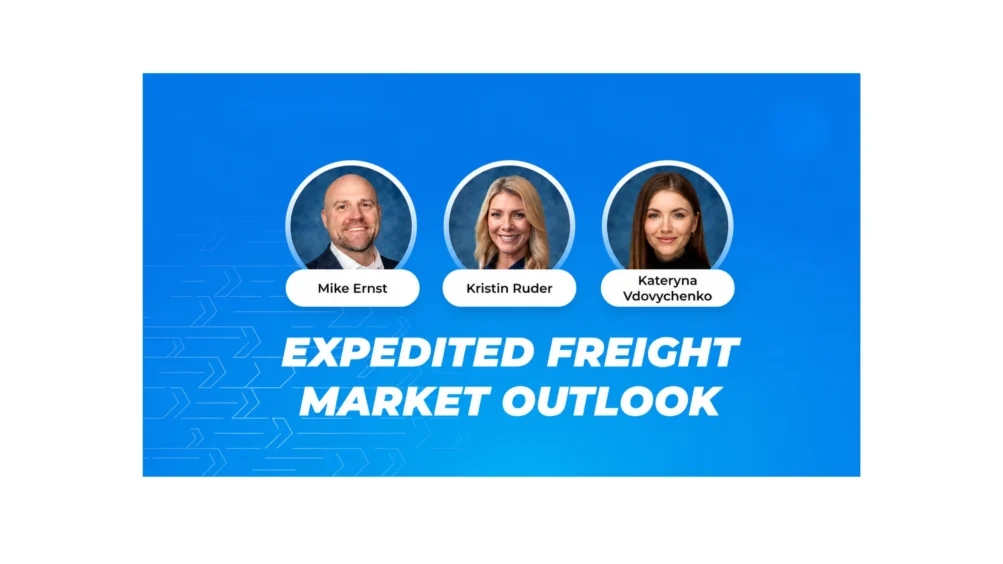
Expedited Freight Market Outlook
Small Truckload is moving from an unfamiliar concept to a practical freight option for more brokers, shippers, and 3PLs.
In this conversation, Mike Ernst, President of Expedite All, and Kristin Ruder, Vice President of Strategic Partnerships, discuss the forces driving STL adoption, what customers expect from time-critical transportation, and where the market is heading next.
Why demand for STL is growing
Several shifts are changing the way freight moves:
- shipment sizes are getting smaller
- customers expect shorter lead times
- businesses are managing inventory more carefully instead of committing capital to large quantities of product
Mike points to changing driver availability, faster delivery expectations, and shrinking shipment sizes as major factors behind the growth of Small Truckload.
“There’s a new need for that STL, that Small Truckload solution.”
The result is a growing space between traditional LTL and Full Truckload. Companies still need dedicated transportation, but increasingly without the size or cost structure of a 53-foot trailer.
High-value and fragile freight are leading adoption
Some freight exposes the limitations of traditional modes faster than others.
High-value shipments often require dedicated service and stronger control. Fragile freight creates a similar challenge: repeated handling can increase the chance of damage, while specialized packaging can add significant cost.
Kristin describes high-value freight as one of the clearest indicators:
“If you have customers that have high value freight, they’re typically looking for something that’s a dedicated solution.”
STL gives customers another option. Instead of defaulting to Full Truckload for dedicated service, a shipment can be right-sized into a sprinter van, box truck, or straight truck while still moving directly from origin to destination.
The same logic applies when fragile freight is producing claims or requiring expensive packaging. A dedicated, no-touch STL move can reduce handling while giving customers more control over the shipment.
What brokers want from an STL partner
As adoption grows, brokers are asking for more than another vehicle option.
Capacity comes first, but speed, safety, and visibility increasingly shape the decision as well.
Kristin summarizes the priorities:
“It’s the capacity, it’s the safety, and it’s the speed to quote and speed to book.”
Expedite All supports customers through a network of 12,000+ smaller commercial vehicles, giving brokers access to sprinter vans, box trucks, and straight trucks across a broad geographic footprint.
Speed matters just as much. In expedited freight, brokers may have only minutes to respond to a customer opportunity. Expedite All averages around 90 seconds to return a quote that can be acted on and booked, helping teams move from request to decision faster.
Visibility adds another layer. Expedite All provides customers with continuous GPS freight tracking through the Customer Portal, giving them a clear view of vehicle movement from booking through pickup and delivery.
Where STL fits between LTL and Full Truckload
Small Truckload is not designed to replace every existing freight mode.
LTL remains useful when price is the priority and the shipment can tolerate a shared network and a more flexible delivery window. Full Truckload remains the right choice when freight genuinely requires trailer capacity.
STL occupies the space in between.
Mike explains:
“The problem we’re solving with our mode is a client’s ”I need more reliability, I need more security, I need more safety with my freight than LTL. But my shipment just isn’t large enough to pay for a 53-footer, or I don’t want to take the risk.”
The mode is designed for shipments that need more reliability, exclusivity, or control than LTL can provide but do not require a full trailer.
That can include high-value freight, fragile products, time-critical parts, temperature-sensitive commodities, and shipments where direct door-to-door movement matters more than simply finding the lowest transportation rate.
Turning STL knowledge into customer growth
Because Small Truckload is still emerging as a defined mode, education remains an important part of adoption.
Brokers first need to understand where STL fits. The next step is recognizing those opportunities inside their existing customer base: smaller shipments moving on Full Truckload, fragile freight experiencing claims, urgent loads, or customers asking for more predictable dedicated service.
Expedite All supports that process through customer education, sales-team discussions, data analysis, and industry training designed to help partners identify where STL can create value.
Kristin describes the importance of turning that education into action:
“The more education that we can have and fully embed ourselves into our customers… then it’s just that cascading effect in essence.”
For brokers preparing for greater STL demand, the opportunity is not simply to add another transportation option. It is to understand where that option solves problems traditional modes do not.
Small Truckload gives customers another way to balance speed, capacity, control, and shipment size — and gives brokers another solution to bring to the conversation.
Need to identify where Small Truckload fits in your freight strategy? Contact Expedite All to explore the right capacity for your next shipment.
You May Be Interested In
Securing the Supply Chain: Innovative Strategies to Combat Rising Cargo Theft
Cargo theft has been a huge problem in the industry. Recent statistics also support this concern, showing a 68% increase in cargo theft compared to last year. Addressing this issue requires developing and applying innovative strategies, some of which we’d like to discuss in this blog and share with you voluntarily…
How to Choose Between LTL and STL Shipping
Making an informed decision between Less-Than-Truckload (LTL) and Small-Truckload (STL) shipping options presents a considerable challenge for businesses seeking to strike a harmonious balance between the efficiency and cost-effectiveness of their supply chains. As the largest small truck network in the United States, offering STL services tailored for time-sensitive, fragile, or high-value shipments, we understand these complexities like nobody else in the shipping business…